
HVAC
Why your restaurant kitchen is too hot, and what make-up air has to do with it
A kitchen exhaust hood removes thousands of cubic feet of air a minute. If nothing is deliberately putting that air back, the building will find its own way, and you will not like it.
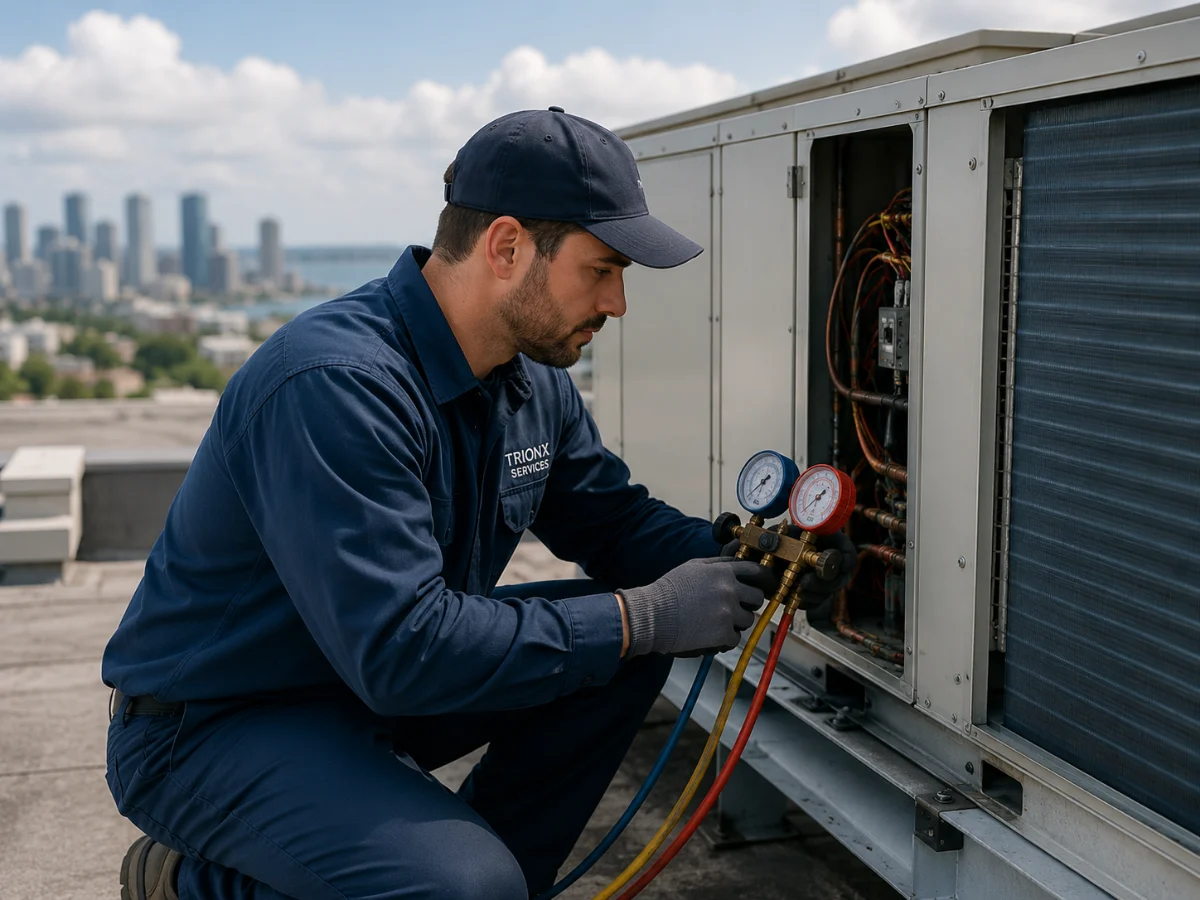
Kitchens that are too hot get blamed on the air conditioning, and the air conditioning is frequently not the problem. In a commercial kitchen the dominant airflow is the exhaust hood, and the single most common cause of an unworkable kitchen is that nothing adequate is replacing the air the hood removes.
This matters more in Miami than almost anywhere, because the air the building draws in to compensate is hot and extremely humid.
What make-up air is
An exhaust hood pulls a large volume of air out of the kitchen continuously, taking grease, heat, steam and combustion products with it. That volume has to be replaced, and make-up air is the system that deliberately supplies it, usually through a dedicated unit that brings in outside air near the cooking line.
Where make-up air is missing, undersized or switched off, the replacement air still arrives. It simply arrives through whatever gaps the building has: door seals, gaps around the frame, the dining room, the roof, and any other opening it can find. That is what a building at negative pressure means in practice.
What negative pressure looks like on site
The symptoms are distinctive once you know them, and they are usually reported as unrelated complaints.
- Doors that are hard to open, or that pull shut with force. An entrance door on a busy kitchen that has become heavy is a pressure symptom, not a hardware fault.
- Whistling or draughts around doors and windows, which is air being pulled through gaps at speed.
- Kitchen smells reaching the dining room or, worse, drifting through the building, because air is being drawn from the front of house across the line.
- Hoods that no longer capture. A hood starved of air cannot pull properly, so grease and steam escape into the room, which is a fire risk as well as a comfort problem.
- Pilot lights blowing out or combustion appliances behaving oddly, which is the most serious symptom on the list and should be dealt with immediately.
- Air conditioning that cannot keep up anywhere in the building, because it is being asked to condition an unmeasured volume of outside air arriving through the walls.
Why Miami makes it worse
In a dry climate, uncontrolled infiltration is mainly an energy problem. Here it is also a moisture problem. Every cubic foot of unconditioned Miami air pulled into a building brings humidity with it, and that load lands on cooling equipment that was never sized for it.
The result is a kitchen that stays hot and a building that stays humid regardless of how hard the air conditioning runs, along with condensation appearing on surfaces in back of house and, over time, the sort of moisture problems that are far more expensive to resolve than the airflow that caused them.
Where it goes wrong
The kitchen changed and the air did not. This is the most common by a distance. A hood is extended, a second one is added, or a fryer and a char grill replace lighter equipment, and the exhaust volume rises without anyone revisiting the supply. Very common in converted buildings where the mechanical services were designed for a previous use entirely.
The make-up air unit is switched off. Sometimes deliberately, because it is noisy or because somebody decided it was heating the kitchen, and sometimes because it failed and nobody noticed. A make-up air unit that has been off for a year will have been off since roughly the time the complaints started.
Interlocks are not working. Make-up air and exhaust are normally interlocked so the supply runs whenever the hood does. When that control fails, the hood runs alone and the kitchen goes negative every service.
The supply is in the wrong place. Make-up air introduced too far from the cooking line, or aimed badly, can disturb capture at the hood while still delivering the volume on paper. This is a design issue rather than a maintenance one and it needs measuring rather than guessing.
What a proper assessment involves
The honest answer to a hot kitchen is measurement, not a guess about the air conditioning. That means measuring exhaust volume at the hood, measuring what the make-up air unit is actually delivering as opposed to what it is rated for, checking building pressure relative to outside, and confirming the interlock does what it is supposed to.
What comes out of that is usually specific and often cheaper than expected: a failed interlock, a filter nobody has changed, a belt, a unit that was switched off, or a genuine shortfall in supply volume that needs addressing properly.
It is worth doing before spending money on cooling capacity, because adding tonnage to a building that is pulling in unmeasured outside air treats the symptom and leaves the cause running. The same reasoning applies to the podium restaurants under Brickell towers, where a kitchen at negative pressure affects the floors above it as well as its own dining room.
Keep reading
Related field notes
Need something looked at?
Tell us the property and the problem, and we will come back with a window.