
HVAC
Commercial AC not cooling: what to check before you call
A fair share of no-cooling calls turn out to be something the site could have settled in five minutes. The rest go considerably faster when the right information is ready before the phone rings.
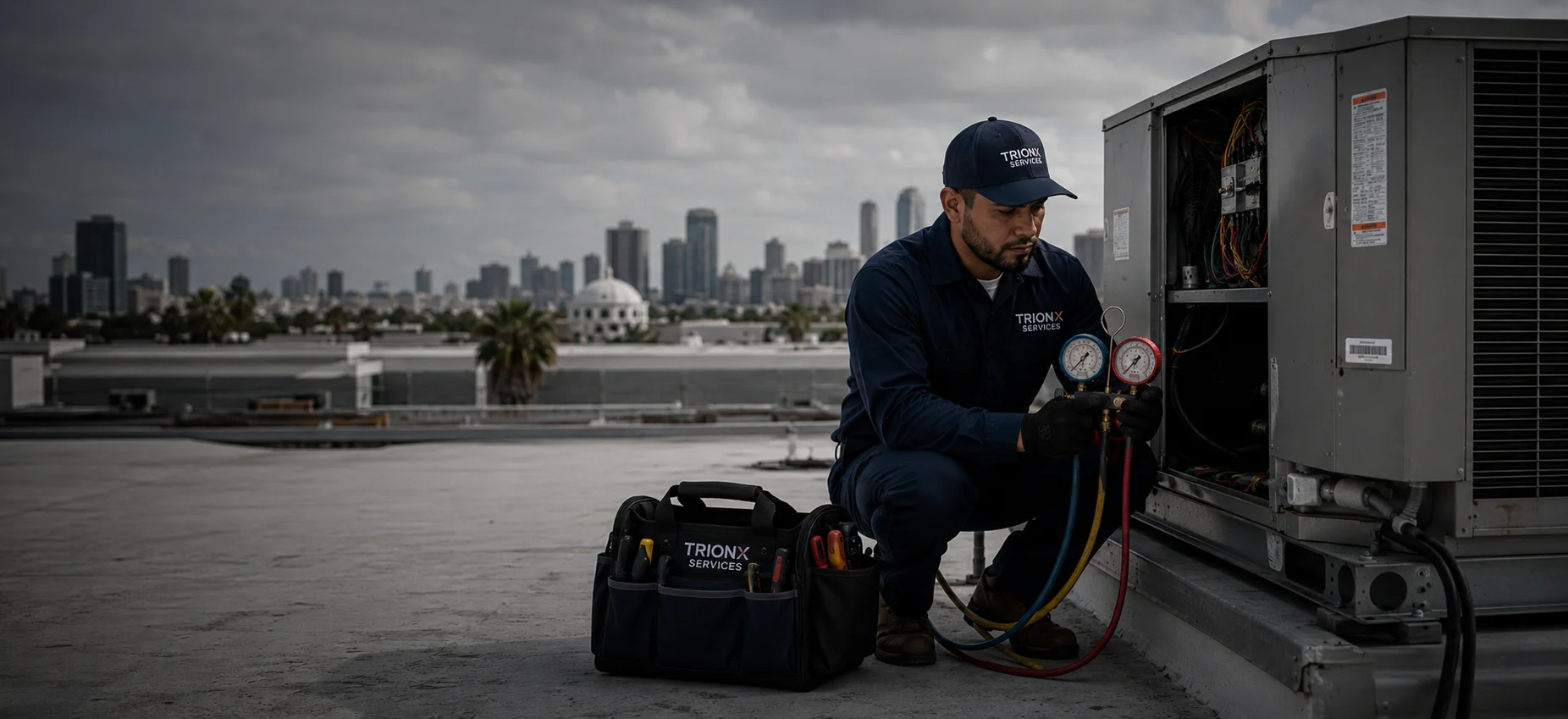
Nothing in commercial property generates a call faster than a space that has stopped cooling. In Miami it also gets expensive quickly, because a building that loses cooling in August takes on humidity within the hour and starts affecting stock, equipment and staff long before anyone is uncomfortable enough to complain twice.
What follows is a short walk-through anyone on site can do safely. It is not a repair procedure and none of it involves opening a panel or touching refrigerant. The point is to separate the problems that resolve themselves from the ones that need a technician, and to have the useful facts ready either way.
Start at the thermostat, however obvious that sounds
More no-cooling calls trace back to a control than to a compressor. Confirm the unit is in cooling rather than fan-only or auto, and that the setpoint is genuinely below the room temperature. On a programmable thermostat, check whether a schedule has taken over: an overnight setback that was fine in March is not fine when the building starts trading at six in July, and a setback that never released is one of the most common causes of a warm morning.
If the display is blank, the thermostat has lost power. That is a real fault and worth reporting, but it is a different fault from a failed compressor and it tends to be quicker and cheaper.
Where a space has multiple thermostats, find out which one actually serves the area that is warm. In multi-tenant buildings the zoning frequently does not match the walls, and a good number of complaints turn out to be someone adjusting a control for a space they are not in.
Filters and return air
A blocked filter starves the system of airflow. The coil ices up, the airflow drops further, and the space stops cooling while the unit runs continuously and sounds like it is working hard. It is the single most common cause of poor cooling in commercial space, and it is the one thing on this list a site can genuinely fix without a technician.
Check the return air grilles as well. Stock stacked against a return, a display moved in front of one, or a partition put up during a fit-out will all produce the same symptom as a dirty filter. This happens constantly in retail and in warehouses after a racking change.
If you find ice on the pipework or the coil, turn the system off and leave the fan running to thaw it before anyone tries anything else. Running a system with an iced coil is how a compressor gets damaged, and the damage costs a great deal more than the call.
Look at the breaker, once
Find the breaker or disconnect serving the unit and see whether it has tripped. If it has, you may reset it once. If it trips again, stop and call. A breaker that will not stay reset is protecting the building from something, and the correct response is a diagnosis rather than a third attempt. That is one of the situations we treat as an emergency call rather than a scheduled visit.
On three-phase equipment there is an additional wrinkle worth knowing about. A unit can lose one phase and keep running on the remaining two, drawing high current and cooking its own windings while appearing to work. Nothing on site will reveal that, which is why repeated tripping on industrial equipment deserves a proper load test rather than a component swap. There is more on this in our note on electrical work in Doral.
Outside at the condenser
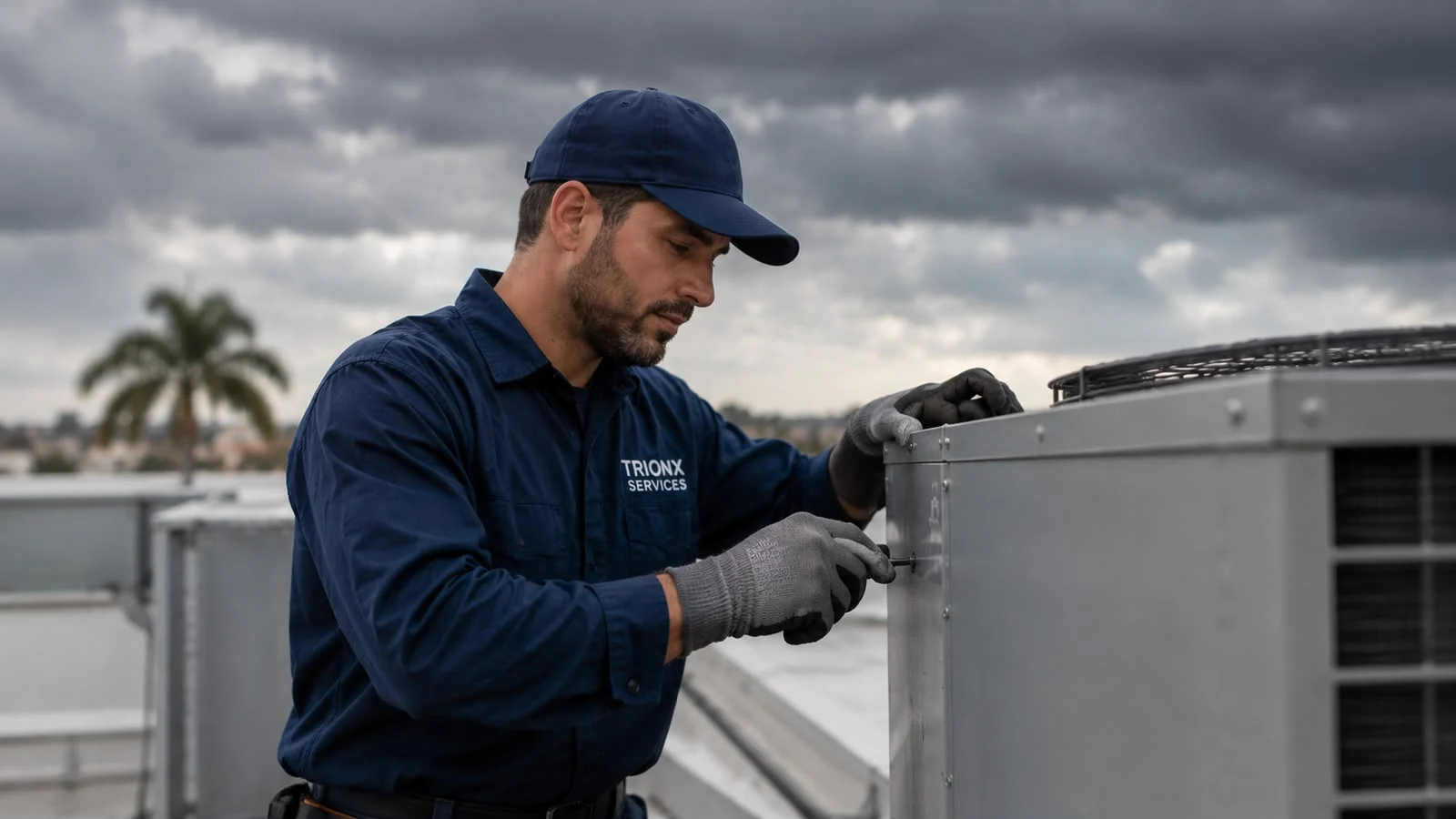
Walk out to the condensing unit or up to the rooftop unit if you can get there safely. You are looking for three things and none of them requires tools.
- Is the fan turning? A condenser fan that is not running while the compressor is means the system is about to shut down on high pressure, if it has not already.
- Is the coil visibly blocked? Landscaping debris, cardboard, plastic wrap and cottonwood all end up plastered against condenser coils. In coastal Miami you are also looking for corrosion and salt deposits, which is why properties near the water need shorter service intervals than the manufacturer suggests.
- Is there anything obviously wrong? Oil staining, a burning smell, an unusual noise, water where water should not be. You do not need to interpret any of it. You need to be able to describe it.
Do not remove panels, and do not try to clear a coil with a pressure washer. Condenser fins bend at almost no pressure at all and a flattened coil is a worse problem than a dirty one.
What to have ready when you call
Assuming the walk-through has not resolved it, the following turns a diagnostic visit into a repair visit far more often:
- The property address, and where in the building the equipment is
- Make, model and serial number from the unit label, photographed if it is easier
- What is actually happening: no cooling at all, some cooling but not enough, cooling that stops after an hour
- When it started, and whether anything changed around then
- Whether the breaker has tripped, and how many times
- Access details, including whether building management needs to approve entry and how late anyone can be on site
Model and serial matter more than people expect. They determine which parts are carried on the van, and on older equipment they determine whether a part is still available at all. A technician who knows the model before leaving has a real chance of finishing the job on the first visit.
What it usually turns out to be
In commercial space the recurring causes are dull and consistent. Blocked filters and restricted return air. Condenser coils nobody has cleaned since installation. Failed capacitors and contactors, which are inexpensive parts that stop a large unit dead. Low refrigerant charge from a slow leak, where topping it up without finding the leak means doing it again next season. Thermostats and schedules that no longer match how the building is used.
Almost every one of those is cheaper to prevent than to repair, which is the entire argument for scheduled servicing rather than reactive call-outs. A unit on a maintenance programme has its filters changed, its coils cleaned and its electrical connections checked before any of it becomes a summer emergency at out-of-hours rates.
Need something looked at?
Tell us the property and the problem, and we will come back with a window.