
Facilities
What a proper work-order closeout should contain
Most maintenance disputes are not disagreements about facts. They are disagreements that exist only because nobody wrote the facts down.
Here is a document that arrives at property managers constantly:
Service call, HVAC. Repaired unit. $840.
That is not a record. It is a request for payment with a noun attached. It cannot support a warranty claim, cannot establish whether this is the first failure or the fourth, cannot settle whether the cost belongs to the landlord or the tenant, and cannot be used to argue for capital replacement at the next budget cycle.
Below is what a closeout should actually contain, and why each element earns its place.
Identification: which asset, exactly
Not "the rooftop unit" but the specific one: location on the roof, manufacturer, model number and serial number.
Properties have multiple units. Without unambiguous identification you cannot build a service history per asset, which means you cannot see that unit 3 has now been attended four times in eighteen months while units 1, 2 and 4 have needed nothing. That pattern is the single most valuable thing a maintenance file can tell you, and vague identification destroys it.
Model and serial also determine warranty eligibility and parts compatibility. Recording them once saves a trip every subsequent visit.
Findings: what was actually wrong
The reported symptom and the diagnosed cause are different things, and both belong in the record.
"Tenant reported no cooling" is the symptom. "Failed run capacitor; condenser coil heavily fouled, likely contributing" is the finding. The second tells you something the first cannot: that there is an underlying maintenance issue which will cause this again.
Measurements belong here too where they are relevant: refrigerant pressures, temperature differentials, voltage and current readings. They are what makes a later comparison possible. A unit drawing more current than it did six months ago is telling you something, but only if somebody wrote down the earlier figure.
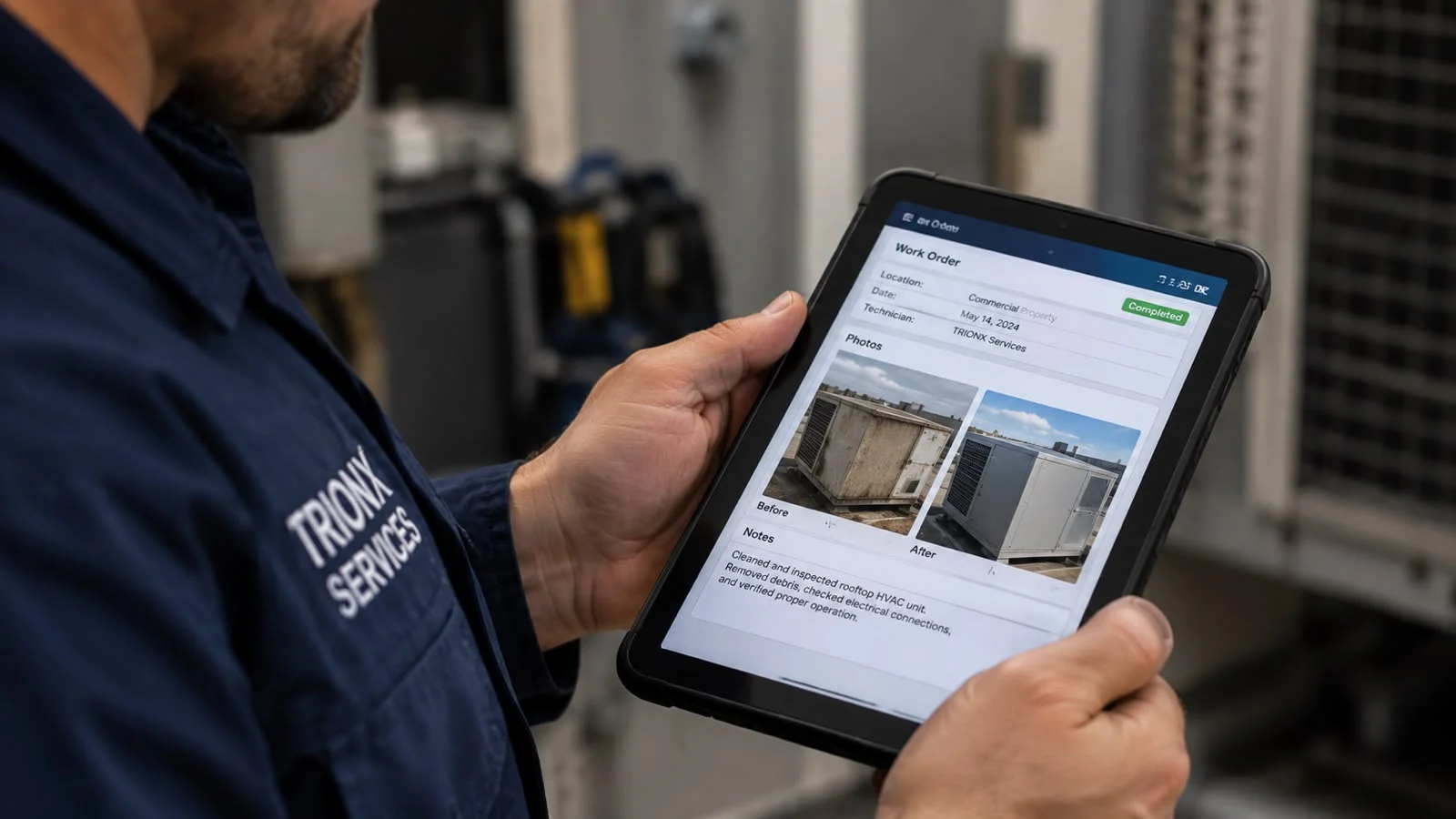
Photographs: before and after
Photographs are the element most often missing and the one that does most work.
Before establishes the condition found. This matters for insurance claims, for landlord-tenant disputes, and for demonstrating that damage was pre-existing rather than caused during the visit.
After establishes what was done. Nobody overstates a repair when the file contains a photograph of it, which protects you and keeps the vendor honest.
For anything that will be concealed, such as pipework before a wall closes or wiring before a ceiling goes back, the photograph is the only record that will ever exist. Once the drywall is up, nobody is opening it again to check.
Parts and materials
What was replaced, the part number, and whether it was OEM or equivalent. Under warranty, this determines whether the warranty survives. Out of warranty, it determines whether the next technician can source a match without another diagnostic visit.
It also makes the invoice reviewable. A line item of $840 is unauditable. A capacitor, two hours of labour and a coil clean is a figure you can assess and, if necessary, question.
Labour and timeline
When the call was received, when the technician arrived, and how long the work took.
Response time is the metric most property managers care about most and measure least. Without arrival times in the record, "they take forever to turn up" stays a feeling instead of a fact, and you cannot raise it constructively with a vendor or use it to compare one against another.
Recommendations and what was deferred
This is the element that separates a maintenance record from a repair receipt.
If the technician noticed the coil is corroding, the adjacent unit is showing the same symptom, or the real fix is replacement rather than another repair, that observation belongs in the file whether or not it was actioned.
Deferred items are how capital budgets get built with evidence instead of estimates. When you go to your owner asking to replace three rooftop units, "here are eleven service calls across eighteen months, and here are the technician recommendations from each" is an argument. "They are getting old" is not.
Filed when it is still true
Same day. Documentation written a fortnight later is written from memory, and memory generalises. The photographs are on someone's phone, the readings are approximate, and the specific observation that would have mattered has been smoothed into "serviced unit, working on departure".
The test
A simple one: if this asset fails again in fourteen months and a different technician attends, can they tell from your file what was done, what was found, what was recommended, and what parts are in there now?
If yes, the documentation is doing its job. If no, you are paying for the same diagnosis over and over, and that is where a great deal of maintenance budget quietly goes.
This is why photo documentation is one of the four things we commit to on every job instead of selling it as an upgrade. Without it you do not have a maintenance programme, you have a stack of unrelated invoices.
Keep reading
Related field notes

Need something looked at?
Tell us the property and the problem, and we will come back with a window.